Not All Skies Are Equal: The Science of Why Meteorites Favor Certain American Regions
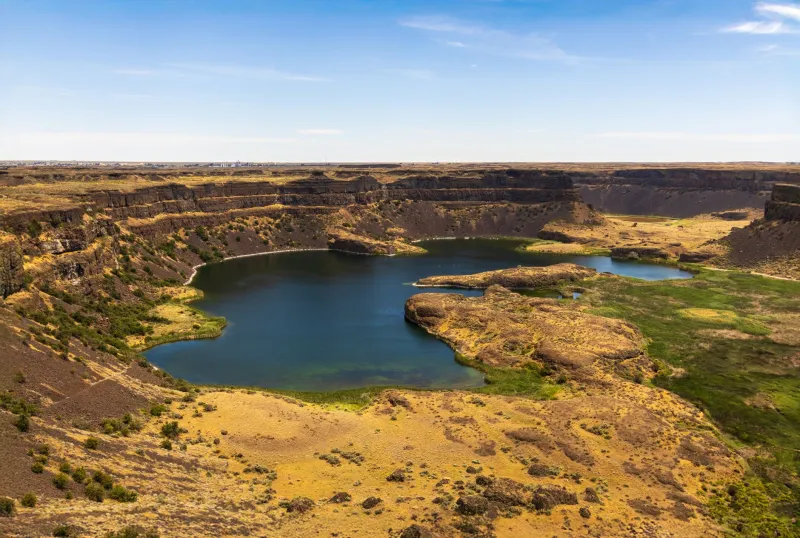
Spend enough time studying meteorite recovery maps, and a striking pattern emerges. Certain corners of the United States appear again and again in fall catalogs and find databases, while equally vast stretches of the country remain conspicuously quiet. This is not coincidence, nor is it simply a matter of where people happen to be looking. The atmosphere itself plays an active role in shaping where space rocks ultimately come to rest — and the geography beneath those skies determines how long they survive once they arrive.
For collectors and scientists alike, understanding the mechanics behind meteorite distribution is more than an academic exercise. It is a practical tool, one that can focus search efforts and deepen appreciation for the specimens that do make it into collections.
The Entry Problem: How the Atmosphere Filters What Reaches the Ground
Every meteoroid that enters Earth's atmosphere faces an extraordinary gauntlet. Traveling at velocities that can exceed 40 miles per second, these objects encounter atmospheric resistance that generates intense heat and mechanical stress. Most disintegrate entirely. The fraction that survives to become meteorites does so through a combination of composition, entry angle, and sheer mass.
But the atmosphere does not treat all incoming objects equally, and it certainly does not distribute them evenly. The angle at which a meteoroid enters the atmosphere determines how much of that atmosphere it must traverse. A shallow entry angle means a longer atmospheric path, which increases the chances of complete ablation. A steeper angle shortens that path but concentrates the thermal load. The sweet spot — the entry geometry that gives a meteorite the best chance of surviving — tends to produce falls in relatively predictable corridors, particularly when combined with prevailing wind conditions at high altitude.
Jet stream positioning is one of the more underappreciated factors in meteorite distribution. High-altitude winds can deflect the trajectory of a falling object, sometimes significantly. During periods when the polar jet stream dips deep into the continental United States — a common occurrence across the central plains in late autumn and winter — incoming objects may be nudged eastward or southward in ways that alter their projected fall zones by dozens of miles.
Why the American Midwest and Southwest Dominate Recovery Records
The central and southwestern United States hold a disproportionate share of documented meteorite recoveries, and the reasons are both atmospheric and geological. The Great Plains offer an almost ideal combination of conditions: flat, open terrain with minimal vegetation cover, low annual precipitation in many sectors, and soils that preserve fusion crusts and oxidation features better than humid eastern environments.
The Sonoran and Chihuahuan Deserts of the Southwest extend this advantage even further. Arid climates dramatically slow the weathering processes that degrade a meteorite's identifying characteristics. A stone that falls in the humid Southeast may lose its fusion crust and acquire terrestrial rust within a few decades. The same stone falling in the dry Southwest might remain identifiable for thousands of years. This differential preservation rate creates a strong bias in recovery statistics — not because fewer meteorites fall in humid regions, but because fewer survive long enough to be recognized.
Latitude also plays a subtle role. Regions closer to the 30th to 45th parallel north — a band that cuts through much of the contiguous United States — experience entry geometries that tend to favor survivable fall angles for certain meteoroid populations. This is partly a function of Earth's axial tilt relative to the ecliptic plane, which influences the angle at which debris from various parts of the solar system intersects our planet's path.
Seasonal Variations and the Timing of Falls
The calendar matters more than most collectors realize. Meteorite falls are not uniformly distributed across the year. Earth's orbit carries it through regions of varying debris density, and the resulting variation in fall frequency is measurable. The months of October through December have historically produced a notable concentration of significant falls in North America, a pattern that aligns with Earth's passage through certain debris streams and the increased density of sporadic meteoroids encountered during that orbital arc.
Winter conditions in the northern plains and mountain states introduce a complication, however. Snowpack can conceal fresh falls for months, and freeze-thaw cycles can move surface stones in ways that complicate recovery. Spring thaw often reveals meteorites that fell during winter, but those same specimens may have already experienced significant moisture exposure. Collectors working in seasonal climates must factor these dynamics into their search strategies.
By contrast, the desert Southwest offers year-round accessibility and consistent surface conditions. Falls that occur in summer monsoon season may be temporarily obscured by flash flooding in arroyos, but the desert floor's overall stability makes it one of the most reliable environments for long-term preservation.
Population Density and the Witness Effect
No discussion of regional fall distribution is complete without acknowledging the role of human observation. A meteorite that falls over a remote wilderness area and a meteorite that falls over a populated suburb face very different odds of being reported and recovered. The United States' uneven population distribution — dense along the coasts and in urban corridors, sparse across the interior West — creates a significant reporting bias.
Fireball networks operated by universities and government agencies have helped address this gap. Automated camera systems positioned across the plains and desert Southwest now capture entry events that would previously have gone unwitnessed, allowing researchers to calculate fall ellipses and dispatch recovery teams within days of a fall. For collectors, monitoring these networks provides real-time intelligence about potential recovery opportunities in accessible terrain.
The emergence of community-based observation platforms has further extended coverage into rural areas where institutional infrastructure is sparse. Dashcam footage, security camera recordings, and reports from ranchers and farmers have all contributed to documented recoveries in recent years — a reminder that the collector community itself functions as a distributed sensor network of considerable value.
What This Means for the Serious Collector
Understanding regional fall dynamics is not merely theoretical knowledge. It directly informs where a collector invests time and resources. The arid basins of Nevada, Utah, Arizona, and New Mexico remain among the most statistically productive search environments in the country. The flat, dark-soiled fields of Kansas and Nebraska offer visibility advantages that make systematic grid searches practical. Even parts of Texas and the Oklahoma panhandle, with their combination of open terrain and relatively low rainfall, present compelling opportunities.
For those drawn to the hobby with scientific intent, pairing field knowledge with atmospheric data — tracking jet stream positions, monitoring fireball network reports, and studying historical fall ellipses — transforms meteorite hunting from a matter of luck into something approaching a disciplined methodology.
At Jensen Meteorites, we believe that the rocks themselves are only part of the story. The science of how they arrive, where they land, and why some places yield so much more than others is knowledge that enriches every specimen in a collection. A meteorite is not just a rock from space. It is the survivor of an improbable journey shaped by forces operating at scales from the molecular to the planetary — and the landscape where it finally came to rest is part of that story too.