Space Rocks in the Classroom: How Authentic Meteorites Are Changing the Way Students Learn Science
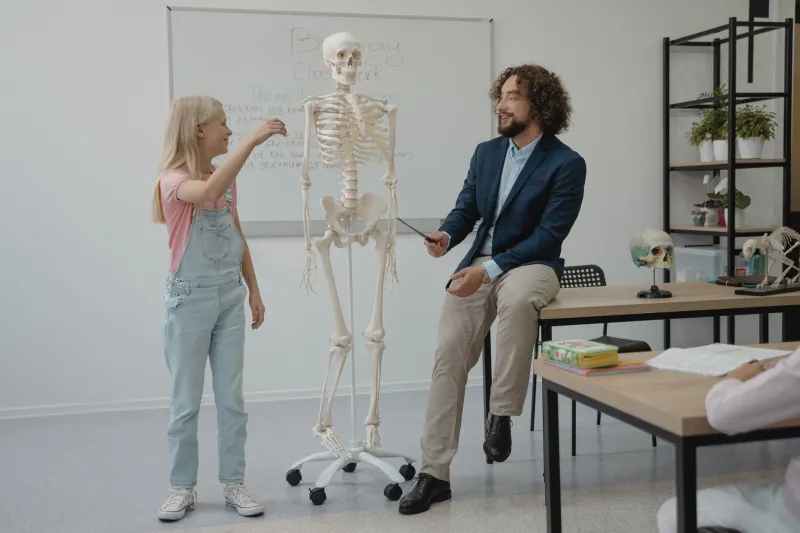
There is a particular moment that experienced science teachers describe in nearly identical terms. A student who has been slouched at the back of the room, disengaged and indifferent, is handed a small, dark stone. The teacher explains, quietly, that the object in the student's palm traveled through interplanetary space for billions of years before landing on Earth. The slouch disappears. The questions begin.
Across the United States, a quiet movement is reshaping how science is taught at the K–12 level, and the catalyst is not a new software platform or a revised curriculum standard. It is a rock — specifically, an authentic meteorite specimen brought into the classroom as a primary learning object.
Why Tangible Materials Matter in Science Education
Decades of research in cognitive science and educational psychology support the premise that hands-on, object-based learning accelerates both comprehension and retention. When students can touch, examine, and describe a physical specimen, they engage multiple sensory and cognitive pathways simultaneously. Abstract concepts — the age of the solar system, the process of planetary differentiation, the chemistry of iron-nickel alloys — become concrete and memorable when anchored to a real object.
Meteorites occupy a uniquely compelling position in this pedagogical framework. They are, simultaneously, geological specimens, historical artifacts, and scientific data sets. A single chondrite can introduce students to mineralogy, radiometric dating, isotopic chemistry, and the early history of the solar system — all within a single lesson period. Few teaching tools carry that kind of interdisciplinary range.
The National Science Teaching Association has long emphasized the value of three-dimensional learning, a framework that encourages students to engage with science as a practice rather than a body of facts to be memorized. Meteorites fit naturally within this model: they invite observation, hypothesis formation, and genuine inquiry.
How Educators Are Putting Meteorites to Work
The approaches teachers have developed vary considerably by grade level, subject area, and available resources, but several models have proven particularly effective.
Comparative density and composition labs. High school chemistry and earth science teachers frequently use small iron meteorite slices alongside terrestrial rock samples to illustrate the concept of planetary differentiation. Students measure density, observe crystalline structure under magnification, and draw conclusions about how heavy elements migrate toward planetary cores. The exercise requires no specialized equipment beyond a scale and a hand lens, yet it delivers a sophisticated lesson in geochemistry.
Geological timescale anchoring. One of the most persistent challenges in earth science instruction is helping students grasp the immensity of geological time. A carbonaceous chondrite, some of which predate the formation of Earth itself, provides a visceral anchor. When students understand that the specimen before them is approximately 4.56 billion years old — older than our planet — the geological timescale ceases to be an abstraction.
Student-led research projects. Several middle and high school programs have moved beyond demonstration-based use to incorporate meteorites into structured research projects. Students photograph specimens, record physical properties, consult published meteorite databases such as the Meteoritical Bulletin, and attempt preliminary classification. These projects mirror authentic scientific workflows and introduce students to the discipline of systematic observation and documentation.
Cross-disciplinary connections. Resourceful teachers have found that meteorites open doors well beyond the traditional science curriculum. A Widmanstätten pattern — the distinctive crystalline structure visible on the polished face of an iron meteorite — raises questions about materials science, manufacturing, and the physics of slow cooling. The history of famous meteorite falls connects to geography, journalism, and cultural history. The legal and ethical dimensions of meteorite collecting can anchor a civics or social studies discussion.
The Practical Question: Sourcing Specimens for Educational Use
For many educators, the primary obstacle is not motivation but logistics. Where does a teacher in rural Kansas or suburban New Jersey obtain an authentic meteorite specimen suitable for classroom use, and how can a school district justify the expenditure?
The answer, increasingly, is that the cost barrier is lower than most assume. Small oriented specimens, meteorite fragments, and thin iron slices are available from reputable dealers at price points accessible to many school budgets. A single verified fragment, properly documented and accompanied by provenance information, can serve an entire classroom for years. Some dealers offer educational pricing or multi-specimen sets designed specifically for classroom use.
Authenticity documentation matters enormously in an educational context. A specimen accompanied by classification data, a reference to its entry in the Meteoritical Bulletin, and a clear chain of custody teaches students, implicitly, about the standards of evidence that science requires. It also ensures that the object being studied is genuinely what it is represented to be — a foundational principle that aligns with the scientific values educators are trying to instill.
Parent-teacher organizations and school foundations have proven receptive to funding meteorite acquisitions when the educational rationale is clearly articulated. Grant programs through state science education associations and private foundations focused on STEM learning represent additional avenues worth exploring.
What Students Take Away
Teachers who have integrated meteorites into their instruction consistently report outcomes that extend beyond content knowledge. Students develop a more personal relationship with the scientific enterprise. They begin to understand science not as a collection of settled answers but as an ongoing process of investigation, and they recognize that the universe's history is not locked away in distant observatories or research institutions — it is, literally, accessible to anyone willing to look.
There is also something that defies easy quantification. A student who has held a piece of the early solar system carries that experience forward. It becomes a reference point, a moment of genuine wonder, that can sustain curiosity through years of more demanding and abstract scientific study.
In an era when science education faces persistent challenges around student engagement and public trust in scientific institutions, that kind of experiential grounding is not a luxury. It is a necessity.
Bringing Space Rocks Into Your Learning Environment
For educators and parents interested in exploring meteorite-based instruction, a few practical steps can ease the process. Begin by identifying a reputable supplier that provides full documentation and is willing to answer questions about specimen selection for educational purposes. Consider starting with a single, versatile specimen — a small iron meteorite slice or a documented chondrite fragment — rather than attempting to build a collection immediately. Pair the physical specimen with reliable reference materials, including published meteorite databases and peer-reviewed resources, so that students understand how their hands-on observation connects to the broader scientific literature.
The universe has been delivering specimens to Earth's surface for as long as the planet has existed. The opportunity to place one of those specimens in a student's hands, and to let the questions that follow guide a lesson, is one that more classrooms should seize.