Ground Zero for the Cosmos: America's Most Accessible Meteorite Impact Sites
The universe rarely announces itself gently. When it does make contact with Earth, it tends to do so with force enough to reshape terrain, alter climates, and leave scars that persist for hundreds of millions of years. The United States is home to several of these scars — astroblemes, as geologists call them — and a remarkable number of them are open to the public. For meteorite collectors, geology enthusiasts, and anyone drawn to the intersection of science and spectacle, visiting an impact site is one of the most grounding experiences the natural world has to offer.
Standing at the rim of a crater or walking through a strewn field where ancient material once rained from the sky provides a visceral sense of scale that no photograph or museum exhibit can fully replicate. What follows is a curated guide to the most significant and visitor-accessible impact sites across the country, along with the science that makes each one worth the journey.
Meteor Crater, Arizona: The World's Best-Preserved Impact Structure
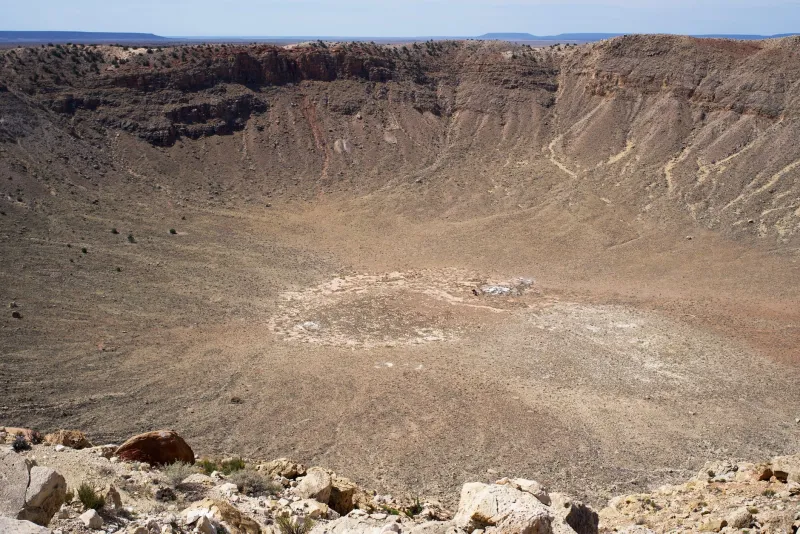
Located approximately 37 miles east of Flagstaff along Interstate 40, Meteor Crater — formally known as Barringer Meteorite Crater — is the undisputed centerpiece of American impact tourism. Roughly 50,000 years ago, an iron-nickel meteorite estimated at 150 feet in diameter struck the Colorado Plateau at speeds exceeding 26,000 miles per hour. The result was a crater nearly a mile wide and 550 feet deep, with rim walls rising 150 feet above the surrounding desert plain.
What makes Barringer exceptional is its preservation. The arid climate of northern Arizona has kept erosion minimal, leaving the crater in a state that scientists describe as essentially pristine by geological standards. It was here that geologist Eugene Shoemaker first conclusively demonstrated in the late 1950s that the feature was formed by a meteorite impact rather than volcanic activity — a finding that fundamentally advanced the scientific understanding of impact cratering throughout the solar system.
The privately operated visitor center sits directly on the crater rim and includes an interactive museum, a viewing platform, and guided rim tours. Fragments of the Canyon Diablo meteorite — the impactor responsible for the crater — are on display and available for examination. For collectors, seeing these fragments in their geological context adds a dimension of meaning that handling a specimen in isolation cannot.
Visitor tip: The rim tour offers the most immediate sense of the crater's scale. Reserve approximately three hours for a thorough visit, and arrive early during summer months to avoid afternoon heat.
The Chesapeake Bay Impact Structure: A Crater Beneath the Water
Not every impact site announces itself with dramatic topography. The Chesapeake Bay Impact Structure, centered near Cape Charles, Virginia, is largely invisible at the surface — because it lies buried beneath the bay itself and the surrounding coastal plain. Formed approximately 35 million years ago when a bolide struck the shallow continental shelf, the structure spans roughly 53 miles in diameter, making it one of the largest confirmed impact craters in the United States and among the best-preserved marine impact structures on Earth.
The crater's existence was not confirmed until the 1990s, when the U.S. Geological Survey identified it through drilling and seismic data. Research since then has revealed that the impact dramatically disrupted subsurface geology across the mid-Atlantic region, affecting groundwater salinity and contributing to the unusual shape of the Chesapeake Bay as we know it today.
While there is no crater rim to walk along, the USGS maintains educational resources about the structure, and the Eastern Shore of Virginia offers a compelling destination for those who want to stand, conceptually at least, above one of the continent's most consequential impact events. The Virginia Aquarium and Marine Science Center in Virginia Beach periodically features programming connected to the bay's geological history.
Visitor tip: Pair a visit to the Eastern Shore with a stop at Kiptopeke State Park, which sits near the crater's outer boundary and offers excellent coastal access and interpretive signage.
Odessa Meteor Crater, Texas: A Modest but Meaningful Site
For those traveling through West Texas, the Odessa Meteor Crater — located just west of the city of Odessa in Ector County — offers an intimate and undervisited alternative to its famous Arizona counterpart. Though significantly smaller at approximately 550 feet in diameter, the crater was formed by an iron meteorite impact estimated to have occurred between 20,000 and 60,000 years ago. Several smaller satellite craters are also present in the area, suggesting a fragmented impactor.
The site is managed by the Odessa Meteor Crater Museum and Foundation, a nonprofit organization that has worked to preserve and interpret the location for decades. The museum displays recovered meteorite fragments alongside educational exhibits, and the crater itself is accessible via a short walking trail. The experience is quieter and more contemplative than Barringer, which suits visitors who prefer unhurried exploration.
Visitor tip: Admission is modest, and the site is rarely crowded. It pairs well with a broader West Texas road trip itinerary that might include Big Bend National Park.
Haviland Crater, Kansas: The Prairie Strewn Field
In Kiowa County, Kansas, a small depression in an otherwise flat agricultural landscape marks the site of the Haviland Crater, also known as Brenham Crater. The impact produced what became the Brenham pallasite strewn field — one of the most celebrated meteorite localities in North American collecting history. Pallasites, with their translucent olivine crystals suspended in an iron-nickel matrix, are among the most visually striking meteorite types known, and specimens from the Brenham fall have been prized by collectors for well over a century.
The crater itself is subtle — a shallow, roughly circular depression about 56 feet across — but the surrounding farmland has yielded significant pallasite masses over many decades. The Greensburg Big Well Museum in nearby Greensburg displays a substantial Brenham specimen and provides regional geological context.
For meteorite collectors specifically, the Haviland site carries a particular resonance. Walking ground that has produced authenticated pallasites connects the abstract appeal of owning a space rock to the tangible reality of where such material originates.
Visitor tip: Permission from local landowners is required before exploring private farmland in the area. Always secure proper authorization before venturing beyond publicly accessible ground.
Why These Places Matter Beyond the Visit
Impact sites are not merely scenic destinations. They are physical records of the processes that have shaped planetary surfaces across the solar system — including the one we inhabit. Every crater, whether a mile wide or a modest depression in a Kansas field, represents a moment when the boundary between Earth and space momentarily dissolved.
For those who collect meteorites, visiting these locations reframes the specimens on their shelves. A fragment of iron-nickel or a slice of chondritic stone ceases to be simply an interesting rock. It becomes evidence of a process still unfolding — a reminder that the solar system is not a static backdrop but an active and occasionally intimate participant in Earth's ongoing story.
Planning a visit to any of these sites is, in its own way, an act of scientific engagement. And for collectors and enthusiasts alike, that engagement is precisely what transforms curiosity into genuine understanding.