Beyond the Desert: The Surprising American States Where Meteorites Are Waiting to Be Found
Ask almost any seasoned meteorite collector to name the best hunting grounds in the United States, and the answers will arrive with remarkable uniformity: the Mojave, the Atacama's northern extension into New Mexico, the dry lakebeds of Nevada. The logic is sound. Arid environments suppress the chemical weathering that degrades fusion crusts and oxidizes iron-nickel metal, and sparse vegetation makes a dark, dense stone stand out against pale caliche and sand. For decades, that conventional wisdom has held.
But the meteorite community is paying closer attention to a quieter set of data points — authenticated finds logged in states that rarely appear in collector folklore. Kansas. Wisconsin. Kentucky. Even parts of the Pacific Northwest. Scientists and experienced hunters who have studied these recoveries say the phenomenon is not accidental. Specific combinations of soil chemistry, precipitation cycles, surface stability, and land use are conspiring to preserve and expose space rocks in places that most collectors have never seriously considered.
Understanding those combinations may represent one of the more significant shifts in American meteorite hunting strategy in a generation.
What Actually Makes a Region Productive
Before examining specific states, it is worth establishing the variables that govern meteorite preservation and discoverability. Weathering grade is the most critical factor. A meteorite that falls in a humid, organically rich environment begins oxidizing almost immediately. Iron-nickel phases convert to iron oxides and hydroxides; the fusion crust softens and flakes. Within decades — sometimes within years — a chondrite can become nearly indistinguishable from a terrestrial iron-bearing concretion.
Climate is therefore paramount, but it is not the only variable. Soil composition matters considerably. Alkaline soils, particularly those with high calcium carbonate content, create a buffering effect that slows oxidation. Regions underlain by limestone or chalk bedrock — a geological signature common across a wide band of the central United States — often produce soils with pH values that are genuinely protective of metallic meteoritic material.
Surface stability is equally important. A meteorite buried beneath an actively tilled agricultural field faces mechanical disruption every planting season. But one that comes to rest in a perennial grassland, a managed pasture, or a shallow-soil rocky upland may remain largely undisturbed for centuries. The longer a specimen sits in a stable, low-disturbance environment, the greater the likelihood that a collector with a metal detector or a sharp eye will eventually locate it intact.
Finally, population density and land accessibility shape the practical discovery rate in ways that are easy to underestimate. Regions with low population density, large parcels of privately held agricultural land, and cooperative landowners represent a fundamentally different opportunity landscape than heavily urbanized areas — regardless of what the underlying geology might offer.
The Kansas Corridor: Limestone, Grassland, and Overlooked Potential
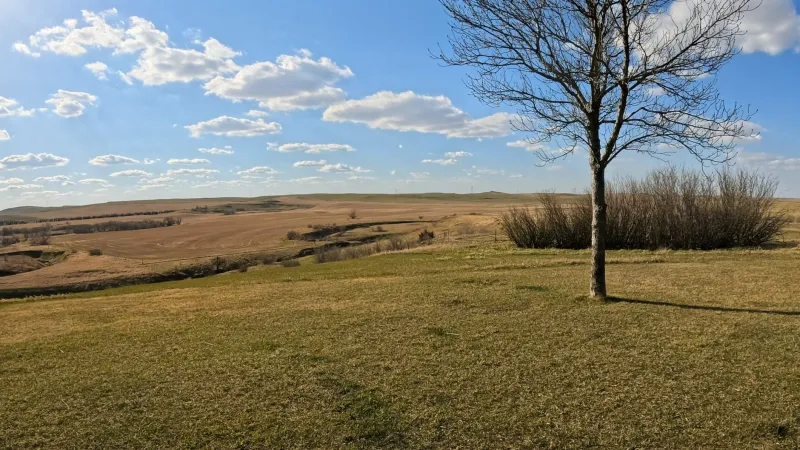
Kansas occupies a position in meteorite history that its reputation has never quite matched. The state sits atop the Flint Hills — one of the last remaining intact tallgrass prairie ecosystems in North America — and underlies much of its surface with Permian and Cretaceous limestone formations. The result is a soil environment that is consistently alkaline, well-drained, and relatively low in the organic acids that accelerate metal oxidation.
Authenticated falls and finds from Kansas stretch back more than a century, and the state's meteorite-per-square-mile recovery rate, when normalized against active search effort, is competitive with better-publicized hunting regions. What Kansas lacks is not meteorites — it is hunters. The absence of a strong regional collecting culture means that an enormous surface area of geologically favorable land receives only sporadic systematic attention.
Collectors who have worked the region describe it as genuinely underexplored. Pasture land that has not been plowed in living memory offers surface stability that few desert environments can match. The challenge is access: Kansas farmland is almost entirely privately owned, and building the landowner relationships required to search it legally takes time and social investment. Those who have made that investment report recoveries that justify the effort substantially.
Wisconsin and the Great Lakes Region: A Cold Climate Advantage
The intuition that cold, wet climates are hostile to meteorite preservation is understandable but partially mistaken. Freeze-thaw cycling does accelerate physical weathering, and the organic-rich soils of the upper Midwest are not ideal for long-term metal preservation. But the Great Lakes region harbors a specific geological feature that creates localized exceptions: glacially deposited till fields and exposed bedrock pavements where soil cover is thin or absent.
In parts of Wisconsin, Michigan, and Minnesota, glacial retreat left behind landscapes of scoured bedrock, shallow rocky soils, and sparse vegetation. Meteorites that fall on these surfaces encounter conditions that are far more preservation-friendly than the surrounding agricultural lowlands. The fusion crust remains intact longer, and the contrast between a dark chondritic stone and pale glacially polished granite or quartzite can be visually striking under the right lighting conditions.
The region also benefits from a phenomenon that collectors sometimes call the "cold storage" effect. Lower average temperatures slow the enzymatic and chemical processes that degrade organic and metallic materials alike. A meteorite that might weather to near-unrecognizability in a decade in Georgia or Louisiana could remain in recoverable condition for several times that span in northern Wisconsin.
Kentucky and the Mid-South: Karst Topography as an Unexpected Ally
Kentucky's karst landscape — the same geological architecture responsible for Mammoth Cave — creates a surface environment of thin, alkaline, calcium-rich soils over dissolving limestone. That chemistry, as noted above, is broadly protective of iron-bearing meteoritic material. More intriguingly, the karst topography itself concentrates surface material in predictable ways. Sinkholes, dry stream valleys, and solution depressions act as natural collection basins, gathering material that washes across the surrounding uplands over long periods.
Several authenticated Kentucky finds have come from exactly these kinds of concentrated surface deposits. Collectors familiar with the state's geology have begun treating karst depressions the way desert hunters treat dry lakebeds — as natural traps that improve the odds of locating specimens that have migrated from their original fall sites.
What This Means for the Serious Collector
The practical implications of these regional dynamics are significant. Collectors who confine their search strategy to the traditional desert corridors are competing for ground that has been systematically worked for decades. The Mojave and the Southwest's dry lakebeds remain productive, but the density of active hunters on that landscape is substantially higher than it was a generation ago.
Emerging regions offer a different calculus: less competition, geologically favorable preservation conditions, and large expanses of land that have received minimal systematic attention. The tradeoff is that non-desert hunting requires different skills — more emphasis on landowner relations, more careful attention to local geology, and a willingness to invest in regions where the recovery rate per search hour may be lower but the potential for significant finds is genuinely higher.
For collectors building a long-term acquisition strategy, the message is worth taking seriously. The next significant American meteorite find is at least as likely to come from a Kansas pasture or a Wisconsin bedrock field as from a Nevada dry lakebed. The science supports that conclusion. The question is simply who is willing to act on it.
Jensen Meteorites carries authenticated specimens recovered from across the United States and beyond. Browse our current inventory or consult our collector resources to learn more about regional recovery patterns and specimen authentication.